AI agents are becoming the investment industry's next workforce. What most people miss is what that workforce needs to stand on; the firms that already built it are about to pull away.
Florian M Spiegl
Founder & CEO
Published
September 1, 2026
Fifteen years ago, Marc Andreessen told us that "software is eating the world." He was right, and the observation has aged into orthodoxy. But look closely at what software actually did: it ate the world as a tool. It waited for human hands. Every system still needed an operator; every workflow still moved at the speed of the people sitting between its screens.
What is eating the world now is different in kind, and it is doing so for good and for real. Software has stopped being a tool and started being a workforce. AI agents now reason, plan and execute multistep financial workflows with limited human input. Everything in the investment process that can be measured will, over the coming decade, be done by machines. That part is no longer a forecast; it is an observation. The interesting questions sit underneath it: what this workforce needs in order to work, why private markets are simultaneously the hardest and the most rewarding place to deploy it, and what becomes possible once it is deployed.
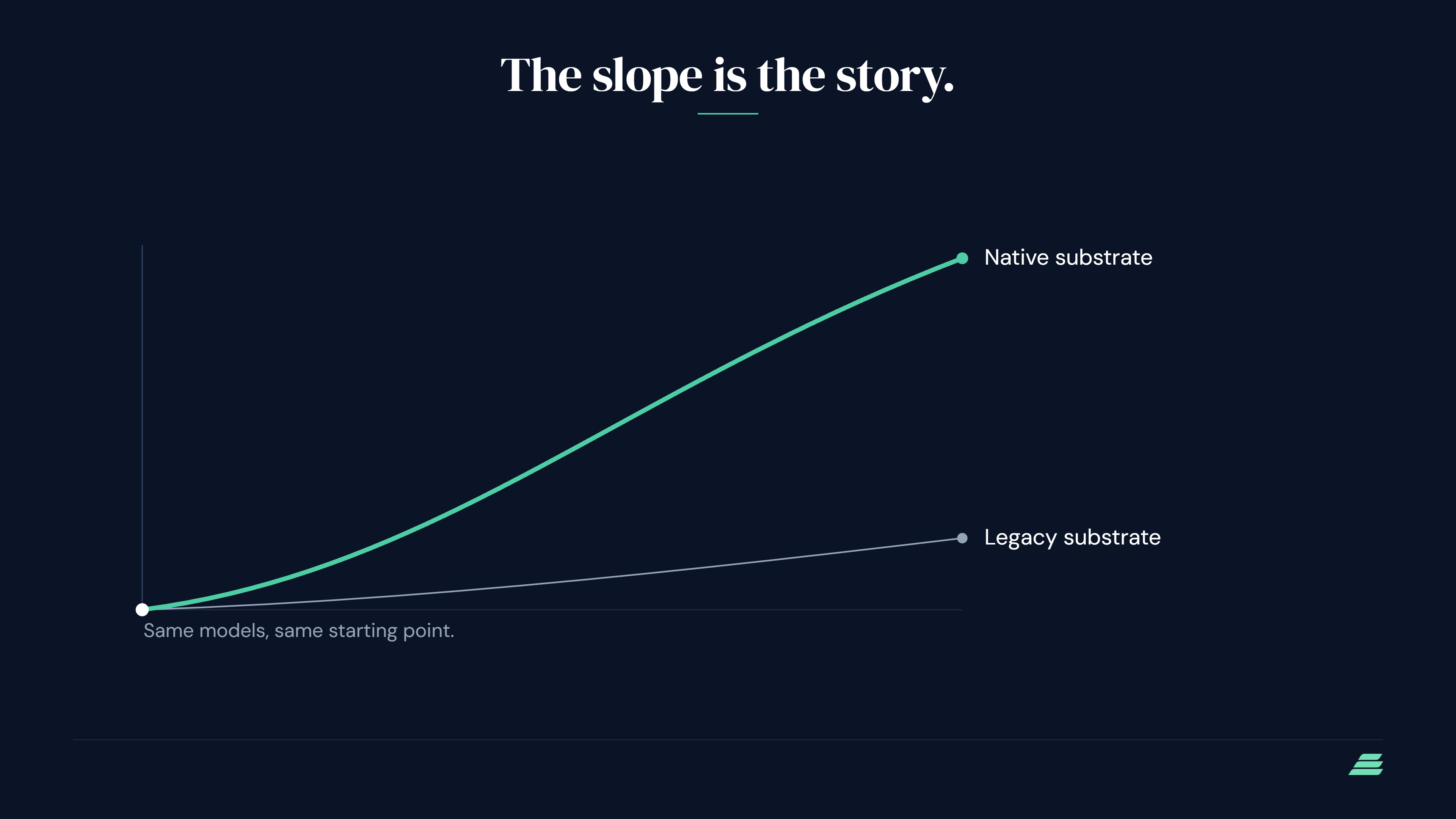
We write this from inside the build. More than twenty AI colleagues now work across our own firm, from deal triage to document production to client servicing, and the honest report from the front line is this: the starting point matters far less than the rate of improvement. This is not about the Y-intercept. It is about the slope.
The workforce has arrived
The evidence is no longer anecdotal; it is showing up in the operating numbers of the world's most conservative corporate function.
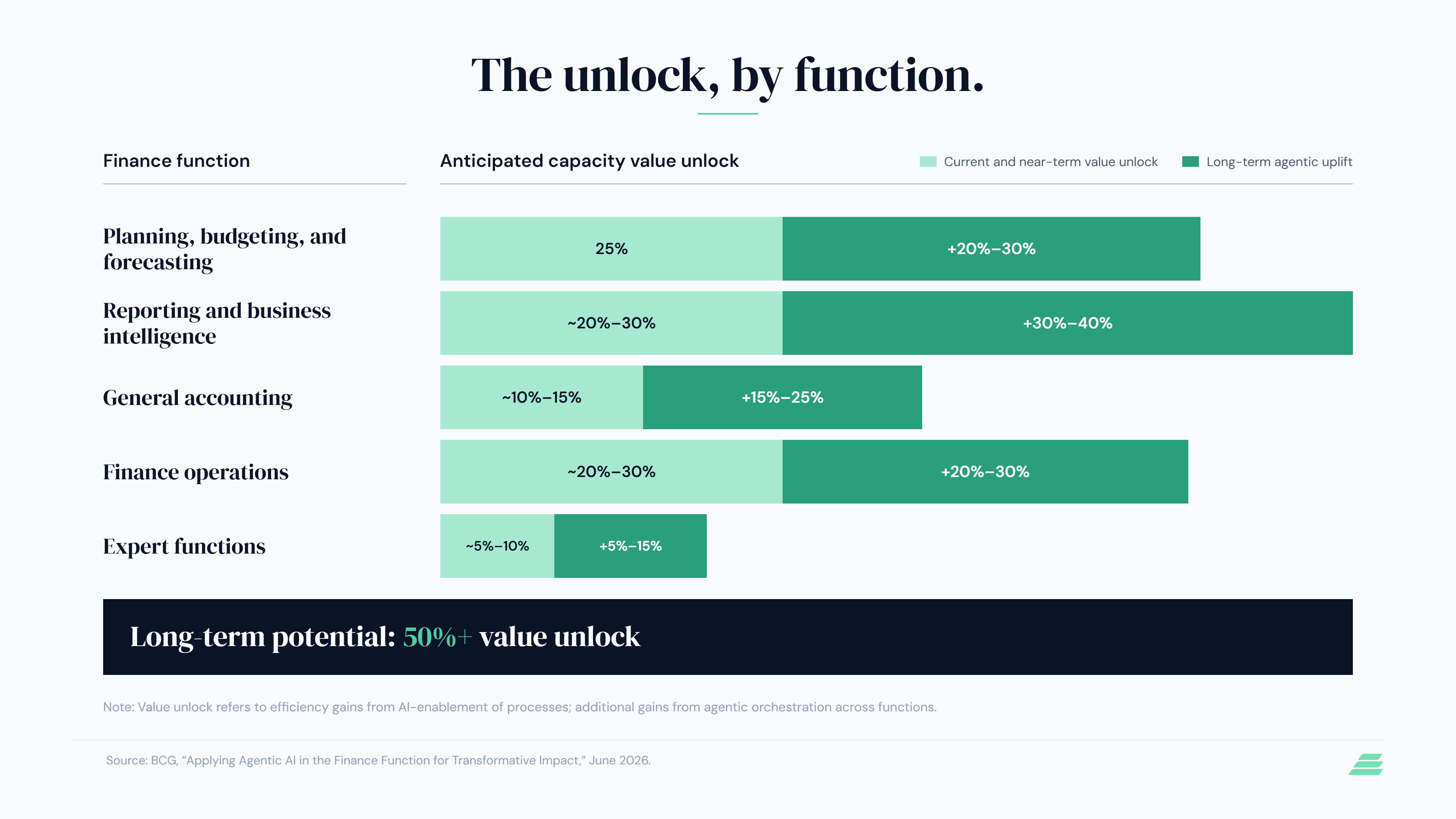
Finance departments are a useful laboratory precisely because they are cautious: audit-bound, control-heavy, allergic to error. The latest survey work from Boston Consulting Group reads, in that light, almost startling. Roughly 88 percent of CFOs now regard AI as essential or important to their priorities, and about 96 percent expect significant or transformative impact within five years. The leaders are past piloting: pioneer organizations are automating around 90 percent of standard reporting, processing more than 80 percent of invoices without a human touch, and freeing over 30 percent of capacity for higher-value work; those that have implemented at scale report returns above 25 percent. In one deployment, variance analysis that took analysts two to three days now takes under thirty seconds.
We read those numbers with recognition rather than surprise. Building with AI every day, we see the same order of improvement inside our own firm: the same collapse in cycle times, the same capacity returned, the same compounding once a colleague has learned a workflow. The laboratory and the coalface agree.
Two details in the evidence matter more than the headlines.
The first is the trajectory. Across the research and the deployments we study, the same capability ladder keeps appearing: from modeling, to reporting, to recommendation, to orchestration, and finally to autonomous execution within guardrails. Every rung already exists in production somewhere. The direction of travel is one-way: toward an always-on finance function, with continuous close, continuous forecasting, and human judgment reserved for exceptions. BCG's phrase for the destination deserves borrowing: the function moves "from a producer of numbers to an architect of value."
The second is where the difficulty lives. By BCG's estimate, only about 30 percent of this transformation is algorithms and technology; roughly 70 percent is the reimagination of processes, roles and controls. The models are ready. The organizations are not. Hold that thought - it decides who wins.
Now extend the logic one step further. If this is what an agentic workforce does to a single corporate finance function, consider what it does to an industry that is, operationally, made of almost nothing else. Strip an investment firm to its processes and you find a chain of measurable, rule-governed work: onboarding and verification, suitability, subscriptions, capital calls, settlement, reconciliation, valuation, reporting, distributions, renewals. Decades of talent have been spent moving data between systems that do not talk to each other. Every link in that chain is exactly the kind of work agents are demonstrably absorbing.
Everything measurable goes to machines. In investment markets, nearly everything between a decision and its completion is measurable.
The workforce needs a workplace
Here is the part the current conversation misses: an agentic workforce is only as good as the environment it operates in, and the environment agents need has very particular properties.
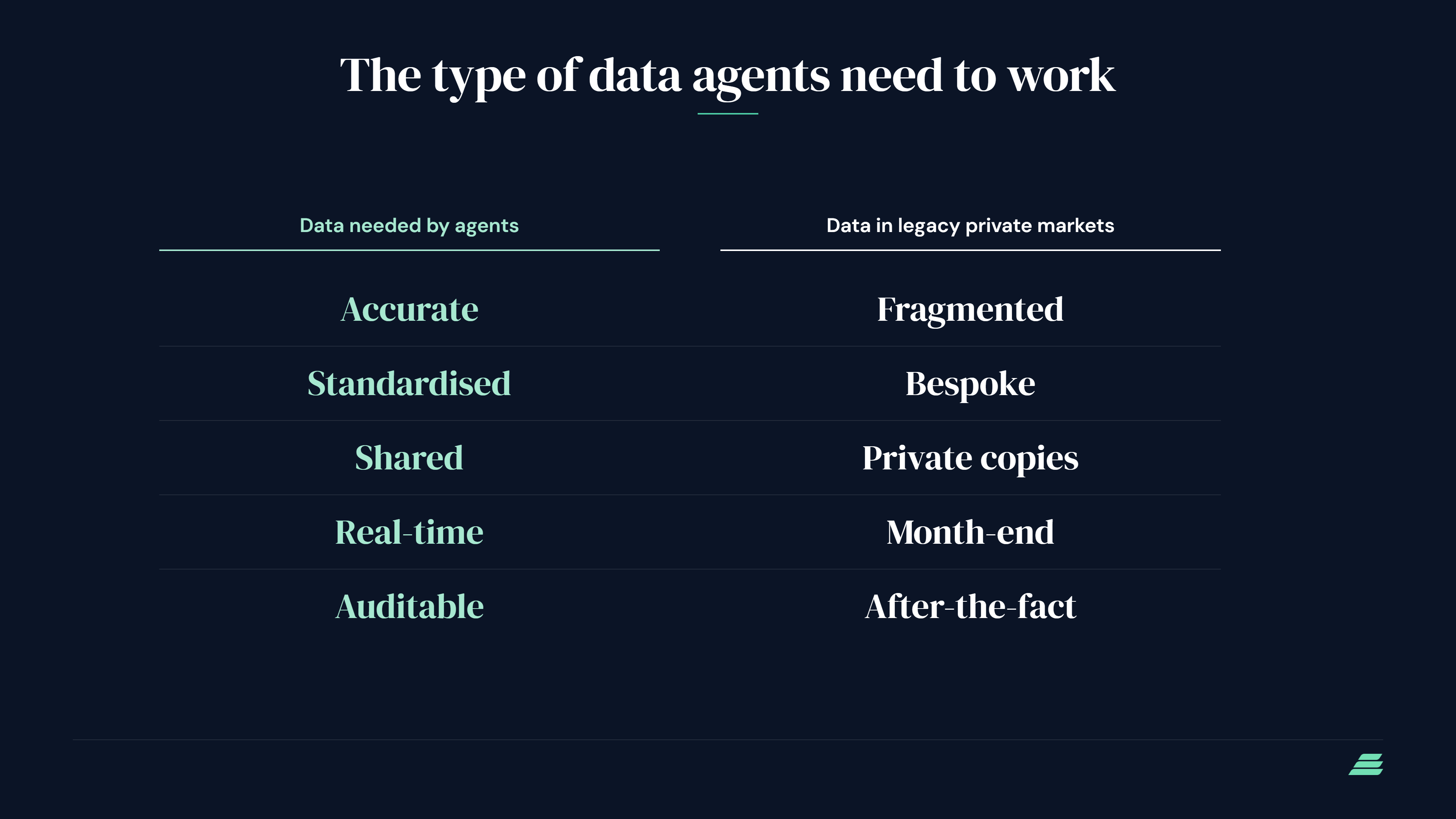
Ask what an AI agent requires to do reliable financial work, and the list writes itself. Data that is accurate and complete. Data that is standardized, so the same fact means the same thing everywhere. Data that is shared, so every party to a transaction reads from one record rather than reconciling private copies. Data that updates in real time, so the agent acts on the present rather than the month-end past. Permissions that are explicit and programmable. And a full, tamper-evident audit trail, because an autonomous workflow without provenance is a regulatory impossibility. One finding repeats across every serious study and every deployment we have run ourselves: what makes autonomy safe is not the model. It is the data foundation and the governance wrapped around it.
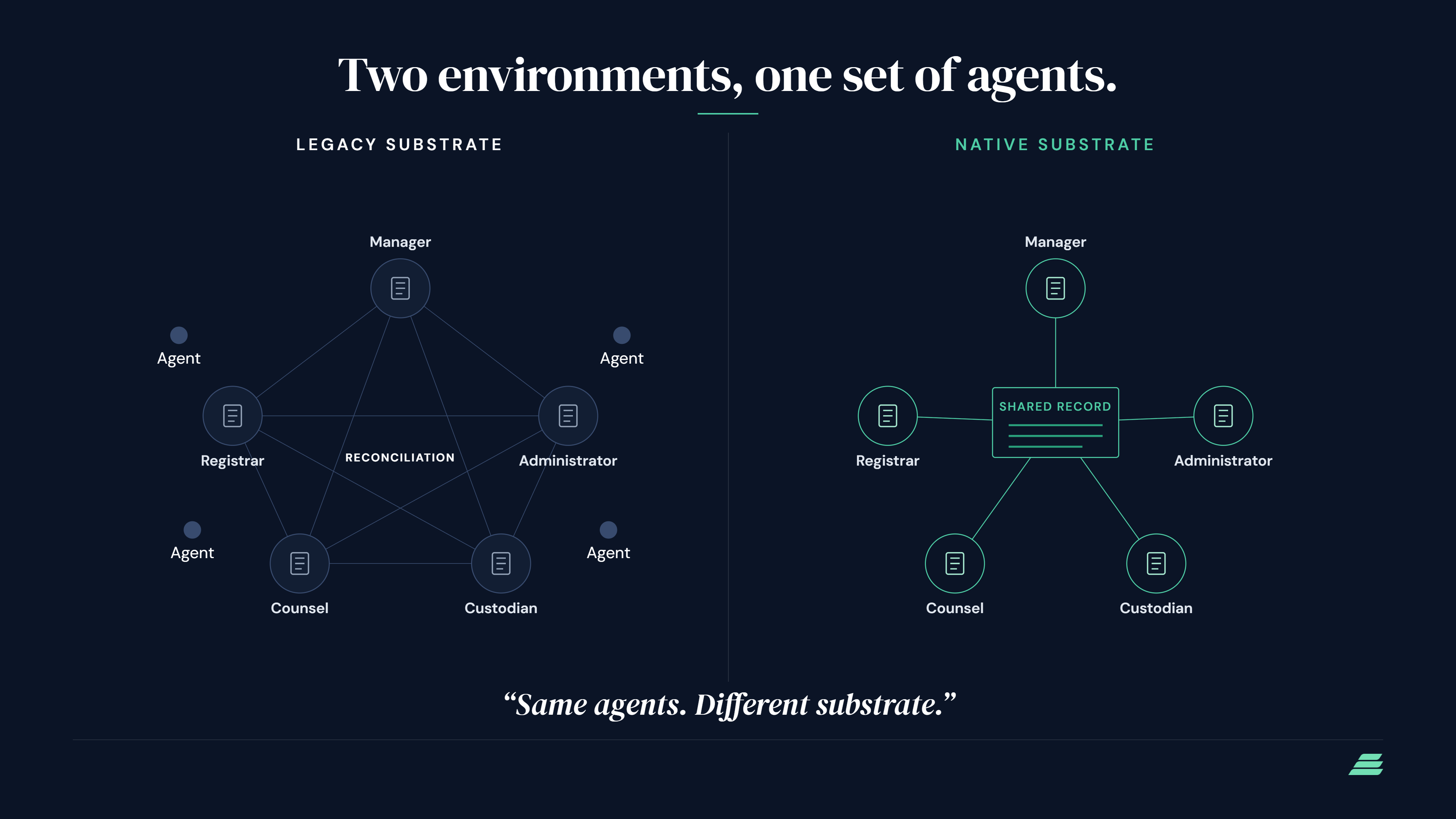
Now hold that list against the operating reality of private markets. Records fragmented across administrators, custodians, lawyers, registrars and spreadsheets. Ownership evidenced in PDFs. Each party maintaining its own version of the truth, with professionals paid to reconcile the differences. Point the world's best agents at that environment and they do not transform it; they inherit it. They spend their intelligence reconciling, which is a waste of something precious.
This is where a technology that most of the investment world filed away as yesterday's hype quietly becomes decisive. Strip the ideology from blockchain and what remains is a humble database with unusual properties: a single record shared by all participants, updated in real time, cryptographically auditable, with rules and permissions written into the record itself. It does not need belief. It needs recognition for what it is: the exact operating environment the agentic workforce requires.
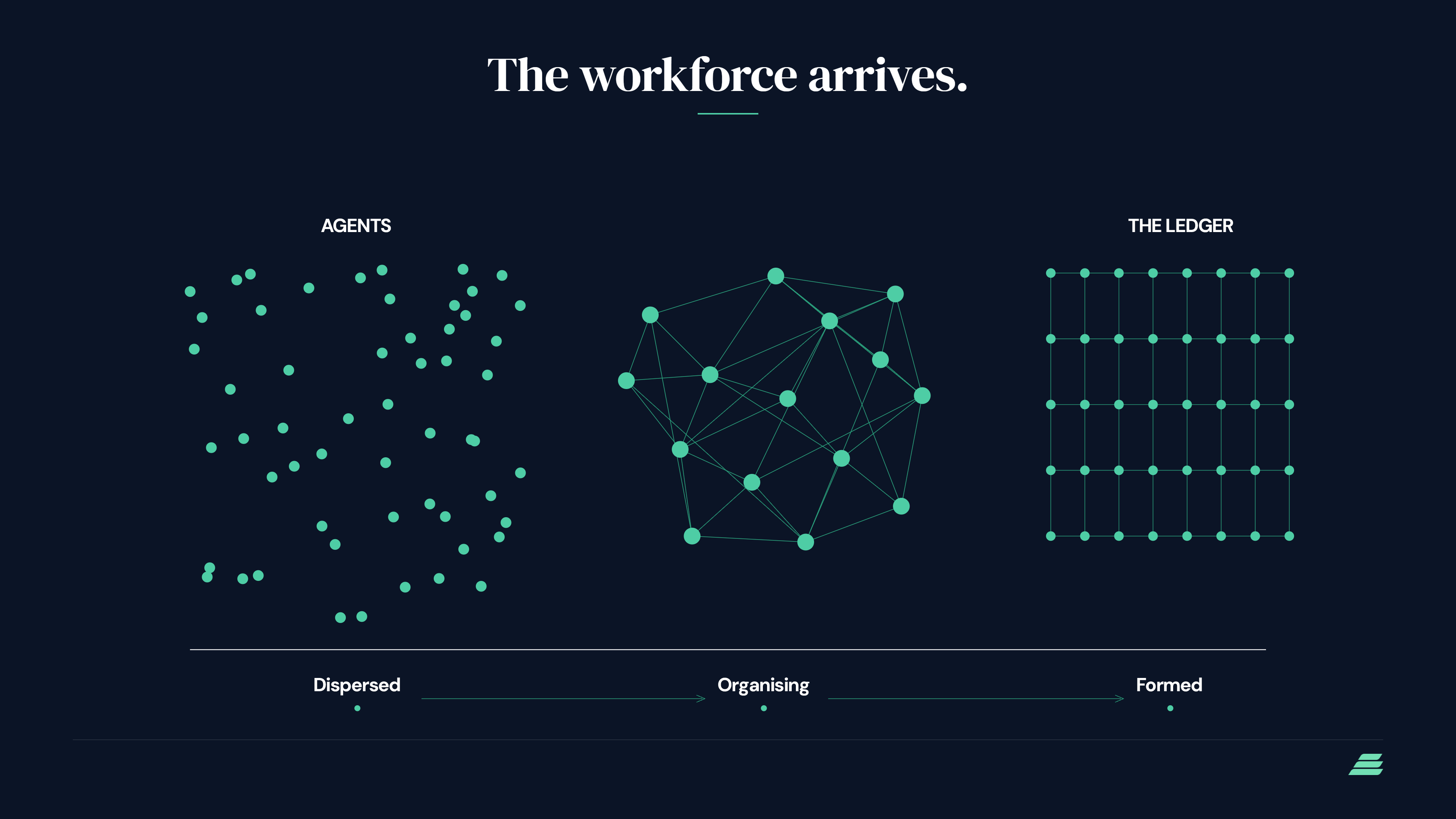
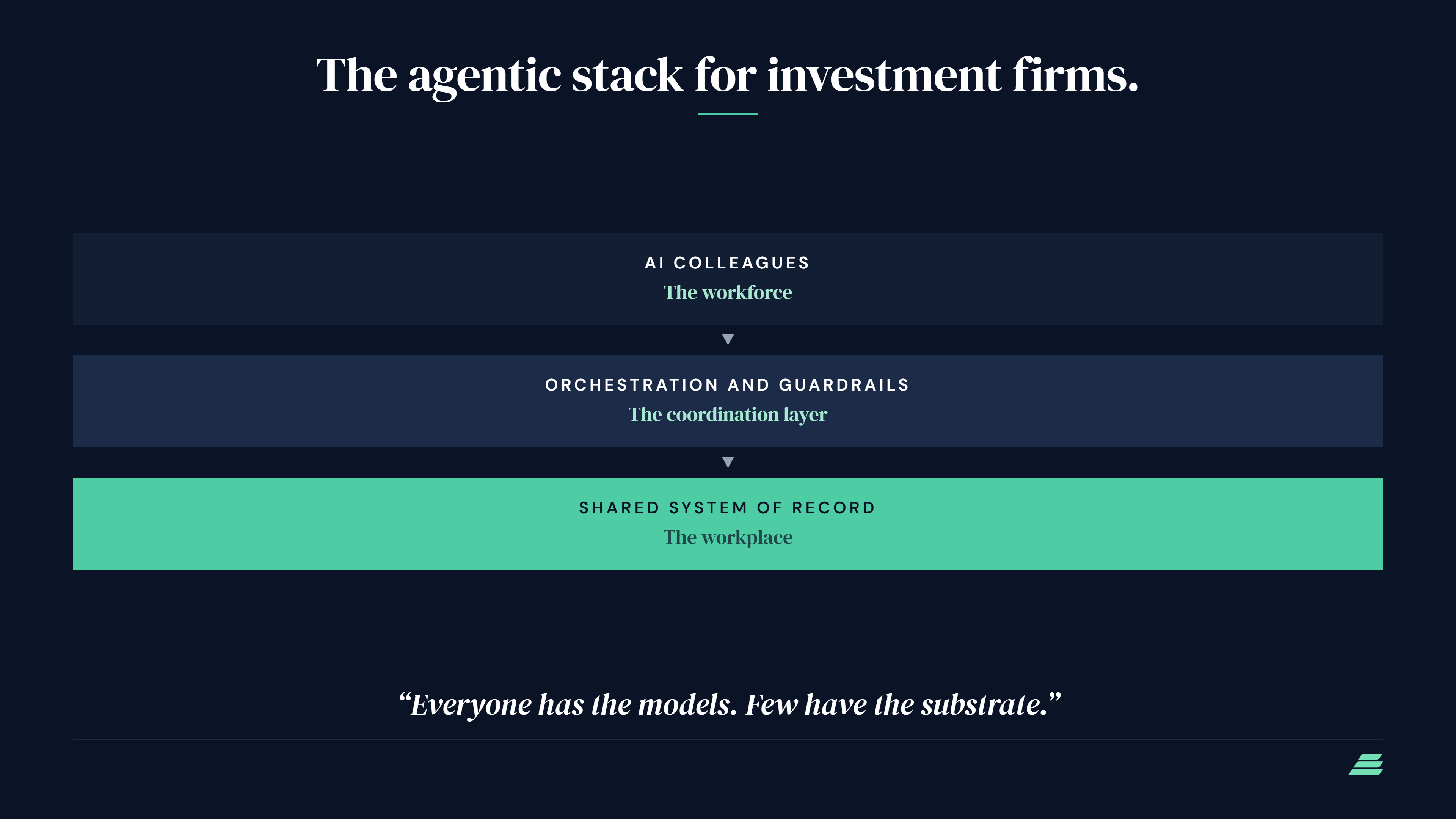
We have described these two technologies before as separate revolutions: the ledger as a new system of record, AI as a new system of orchestration. The observation we would sharpen today is that they are not parallel. They converge. One is the workforce; the other is the workplace. Agents supply the labor; the shared ledger supplies the ground truth that makes autonomous labor trustworthy. Each is powerful alone. Together they compound: the ledger makes agents reliable, and agents make the ledger productive.
That convergence explains something observable right now: agentic adoption will run fastest not where the models are best, since everyone has the same models, but where the data substrate is native. A firm operating on a shared, real-time system of record can hand entire workflows to agents with confidence, because every action is grounded in one verifiable state of the world. A firm operating on fragmented records can deploy the same models and get a fraction of the result. Same Y-intercept; very different slope.
What gets built on top
Once the workforce and the workplace exist together, three consequences follow, in ascending order of magnitude.
The first is access. The reason private markets remained closed to most professional investors was never appetite, and never regulation alone; it was unit economics. Serving a $200 million institutional check and serving a $200,000 professional-investor check involve nearly the same operational work; only one of them could historically afford it. Agents collapse the marginal cost of that work: onboarding, subscription, servicing, reporting, all of it. When the marginal cost of serving an investor approaches zero, the rational market response is not thicker margins on the same clients; it is a wider market. Private markets stop being a stock business rationed by operational capacity and complete their shift into a flow business, open to the full breadth of professional wealth. The infrastructure problem, which was always the real constraint, dissolves into software.
The second is new firms. Recall the finding that roughly 70 percent of the transformation is processes and people rather than technology. That number is usually read as a warning to incumbents. Read it instead as a map of the opportunity: the hardest part of becoming agentic is unlearning, and a firm built natively has nothing to unlearn. This is a familiar pattern; the defining companies of the internet era were not retrofitted, they were founded on the new substrate. The same construction window is open now in investment management. Firms designed from the first day as a small core of specialists directing a large cohort of AI colleagues, operating on a shared ledger, will carry a cost base and a speed that legacy operating models cannot approach by renovation. We expect a generation of such firms. We are, unapologetically, building one.
The third consequence needs the longest lens, so allow a brief detour through history: the firm itself is a technology, and it is a very old one.
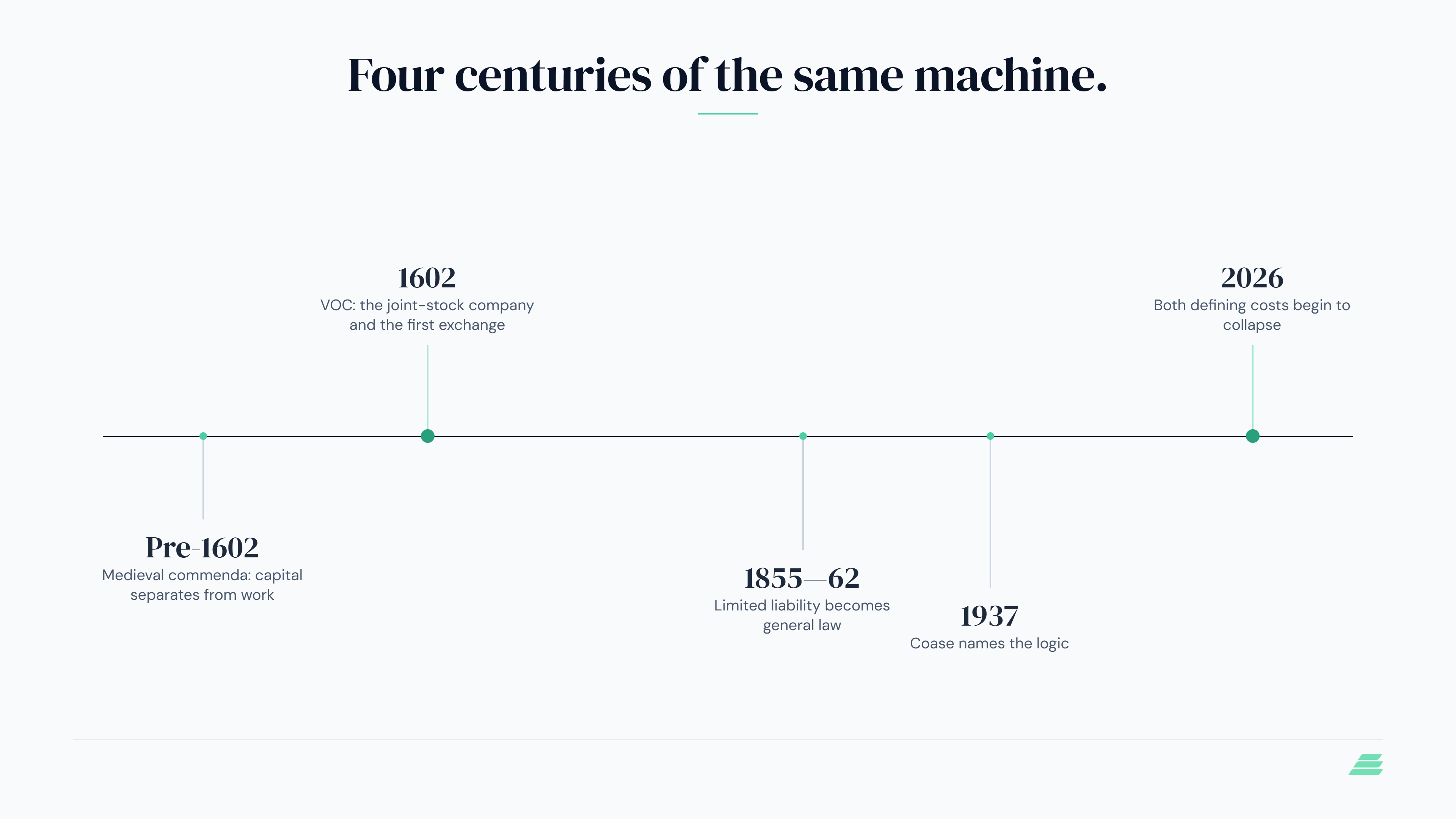
The idea that value could live in a vessel — an entity with its own legal existence, distinct from any person inside it — took centuries to assemble. Medieval Italian merchants built the commenda, splitting the financing of a voyage from the sailing of it: the first clean separation of capital from work. Then, in Amsterdam in 1602, the pieces fused. The Dutch East India Company gave the world the joint-stock corporation: a legal person with transferable shares, limited liability, a register of owners, and delegated management. It was so radical a piece of financial engineering that a new institution had to be invented simply to trade it; we call that invention the stock exchange.
Here is the striking part. Four centuries later, that is still, in its essentials, the machine we use. A legal person. A register. Managers who act, owners who hold, and records kept about the entity rather than in it, reconciled after the fact. Everything inside the vessel has been transformed — telegraph, computer, internet — while the vessel itself has barely changed. Your fund, your SPV, your trust: descendants of Amsterdam, administered in ways their inventors would substantially recognize.
Economics explains why it lasted. In 1937, Ronald Coase asked why firms exist at all, and answered: transaction costs. Coordinating work inside an entity was cheaper than contracting for it outside, and the boundary of the firm settles where those costs cross. I first met this idea during my economics studies, as a theory of the company, and it has stayed with me since: it struck me how simple and yet how profound it was. The most profound things usually are. Every investment vehicle is a Coasean bargain: we bundle records, rules and obligations into a wrapper because keeping them apart was ruinously expensive.
Now watch what the convergence does. Agents collapse the cost of coordination: the very cost that defines the firm's boundary. The shared ledger collapses the cost of verification: the very cost that made registers, transfer agents and reconciliation necessary. The two costs that gave the company its four-hundred-year-old shape are heading toward zero at the same time. When the constraints that shaped a design disappear, the design comes up for renegotiation.
What is a fund when its register, its waterfall and its reporting are live properties of a shared record rather than documents about it? What is a company when most of its operating work is performed by colleagues who are software? These are design questions, not rhetoric, and they will be answered by practitioners and regulators in jurisdictions willing to lead. The joint-stock company was the last great redesign of the vessel that holds collective investment. It shipped in 1602. I believe the next one is being drafted now.
And one counterweight, held with conviction: the end state of all this automation is more human contact, not less. Everything measurable goes to machines precisely so that everything unmeasurable can receive more of the scarcest resource a firm has: senior human attention. Origination. Judgment. Trust. Sitting with a founder; walking an asset; investing together, principal alongside client. The firms that win will not be the ones that automate the relationship. They will be the ones that automate everything else, and then spend the recovered time where no machine can go.
The watershed
Every infrastructure transition looks incremental from inside a quarter and discontinuous from a decade away. The numbers coming out of corporate finance are the early seismograph readings of something much larger: the arrival of a workforce that never sleeps, working on a record that never disagrees with itself.
For investment markets in general, and private markets most of all, we regard this as the watershed: the moment the industry's binding constraint stopped being capital or appetite and became, explicitly, the quality of its operating substrate. The models are available to everyone. The data environment is not. That is where the next decade of advantage will be built.
Software ate the world as a tool, and the world got faster screens. What is eating it now is a workforce; and this time the change reaches the substance: who does the work, what a firm is, and who gets to participate in the returns of private enterprise. We are building for that world, colleague by colleague, and we are happy to compare notes with anyone thinking seriously about the same future.
The builders' decade
Let me end with candor about what nobody knows. No one can tell you precisely what the renegotiated fundamentals will look like, and no one can tell you how fast the renegotiation will run. Anyone claiming otherwise is selling something.
But three things seem clear to me, and together they describe the moment.
First, this is a change in fundamentals, not in features. Not a better interface on the old machine, but new answers to the oldest questions: who does the work, what holds the value, how capital finds enterprise.
Second, it will move faster than the fundamental changes before it. Electrification waited on grids; computerization waited on hardware and a generation of retraining. This transition is carried by software that deploys in weeks and, uniquely, improves itself as it spreads. For the first time, the agent of change is also its own accelerant.
Third, taken together, these two facts open the field. When fundamentals move this fast, incumbency converts poorly, and the advantage goes to whoever builds natively. The dominating firms of the next era of investment markets do not exist yet, or are only now taking shape. They will be defined over the coming decade.
There is no more exciting time to build in investment markets than right now. The opportunities are not incremental; they are foundational. We intend to be among the firms that take them.
The intercept is behind us. The slope is the story.


.png)
.png)


.jpg)
