Hong Kong Sets the Timetable: Traditional Finance Is Moving onto Digital Rails
Within twenty-four hours in September, one financial capital paused its digital-asset rulebook and another published a five-year plan, and a Policy Address, that schedule the move of traditional finance onto digital rails. A first-hand read of what Hong Kong is building.
Florian M Spiegl
Founder & CEO
Published
September 17, 2026
On Tuesday, September 15, the United States Senate voted on whether to open debate on the CLARITY Act, the most comprehensive digital-asset market legislation Congress has produced. After years of drafting and a 630-page final text, the motion needed sixty votes and received forty-nine. The bill will now most likely wait for the next Congress.
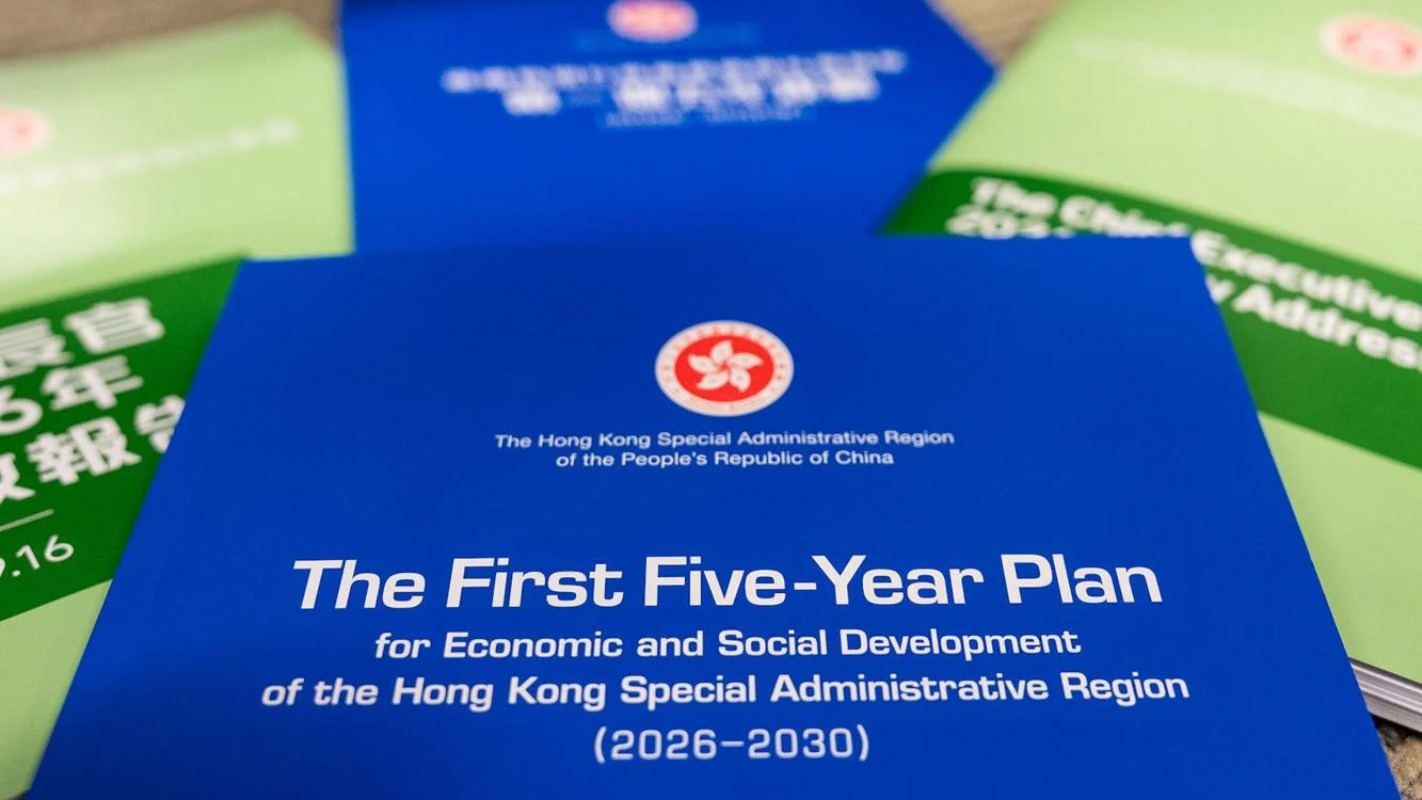
On Wednesday, September 16, less than twenty-four hours later and twelve time zones away, Hong Kong's Chief Executive stood in the Legislative Council and released two documents: the city's first Five-Year Plan in its history, and the 2026 Policy Address that turns it into concrete steps. Inside them, named institution by named institution and deadline by deadline, is something no other financial center has published: a government timetable for moving traditional finance onto digital rails.
Two of the world's great financial centers, on consecutive days, moving at very different speeds. Both will find their way; markets always do. But the contrast is instructive. Both documents range far beyond finance, across housing, health, energy, technology and more, and their initiatives are deliberately interconnected; I focus here on financial services, the part we live in every day. Here is what Hong Kong is building, why it matters well beyond this city, and which asset class we believe comes next.
What a five-year plan makes possible
Before the contents, consider the format itself, because for Hong Kong the format is the bigger innovation.
This month, as it happens, the American political scientist Francis Fukuyama published a memoir, In the Realm of the Last Man. Fukuyama is best known for one of the most debated arguments of the past half-century. In 1989, just before the Berlin Wall fell, he suggested that history, understood as the contest between rival systems of government, was effectively over: liberal democracy had won, and no serious alternative remained. His 1992 book The End of History and the Last Man made the case in full and turned its title into shorthand for an era's confidence.
Thirty-seven years later, he is still returning to the question, and the new memoir returns to it once more. Declaring a final winner was the boldest part of the claim, and it is the part that has aged worst. Perhaps the honest conclusion is the modest one: no system has a monopoly on getting the future right.
I hold no position in that debate, other than being intellectually interested in it. But inside it sits one practical variable that matters enormously to anyone who allocates capital or builds companies, and it deserves to be looked at calmly and on its own: the planning horizon.
Political systems process change on very different clocks. The European Union sits at one end of the spectrum: twenty-seven governments, permanent negotiation, and on important questions a single member can veto the rest. Correction is constant; large decisions can take a decade, and some never arrive. China sits at the other end: it has planned in five-year cycles since 1953, each plan nested within longer-range objectives that currently look out to 2035, and this March it adopted its fifteenth, covering 2026 to 2030. Direction is set for a continental economy, rolled forward and reported against. Commitment is strong; correction is slower. Neither design comes free, and judging them is not the point here. The practical question is simpler: what does a stated five-year direction do for the people who allocate capital and build companies?
Two things. An investor can underwrite direction. When a jurisdiction publishes where it intends to be in 2030 and has its leader report progress against that plan every year, policy direction becomes something you can analyze rather than guess. And a builder can build against it. A company committing capital, people and years of engineering needs to know, at least in broad strokes, where the ground will be when the building is finished. On a five-year horizon, almost nothing is off the table: new market infrastructure, new asset classes, new legal vehicles can be seriously discussed, designed and scheduled. That reliability is worth something real, whatever one thinks of all the other elements of a political system.
Hong Kong has now adopted this format for the first time, aligning its own plan with the nation's fifteenth. Before turning to what the plan says, it is worth describing how it came about, because I saw a part of that process myself. In the months before publication, I had the privilege of joining closed-door sessions in which the government invited practitioners, from established institutions to young firms building at the edge, to say plainly what the industry needs. What impressed me was not the invitation but the seriousness of the listening. That, in my experience, is how this city makes policy: government, traditional finance and new builders working hand in hand, on the conviction that a rising tide lifts every boat. In those same weeks, across the Pacific, a similar dialogue was still counting votes.
As for the plan itself: it sets out where the city intends to be by 2030, across the whole economy, and two of its commitments stand out for financial markets. First, it formalizes Hong Kong's role as an international asset and wealth management center, in the city that this year became the world's largest center for cross-border wealth, ahead of Switzerland. Second, it names the industries in which new companies are to be formed, from artificial intelligence to life sciences to green technology, the last of these to be scaled, in the plan's own words, "through financial and market-driven mechanisms." Put simply: the plan concentrates tomorrow's companies in the same city where the capital already lives.
Plans are nothing without operationalized goals
A plan earns belief only when someone attaches institutions and dates to it. That is what the 2026 Policy Address does, and its center of gravity is unmistakable: digital market infrastructure.
A short clarification. When these documents speak of blockchain, tokenization, or what the market has taken to calling "real-world assets," none of it points to crypto or virtual assets. It all points to traditional assets running on digital rails: government bills, bonds, money market funds, gold, commodities, bank deposits. There is nothing exotic about a government bill; what is new is the infrastructure underneath it.
For us at EVIDENT, this is an arrival rather than a discovery. The gradual replacement of old market plumbing with digital rails, to the benefit of all investors, is the story we have built on for years. What changed last week is that it now sits front and center of a government's agenda, with the machinery named and dated. The transition is under way globally, at different speeds; in Hong Kong, it now runs on a schedule.
What is actually being built
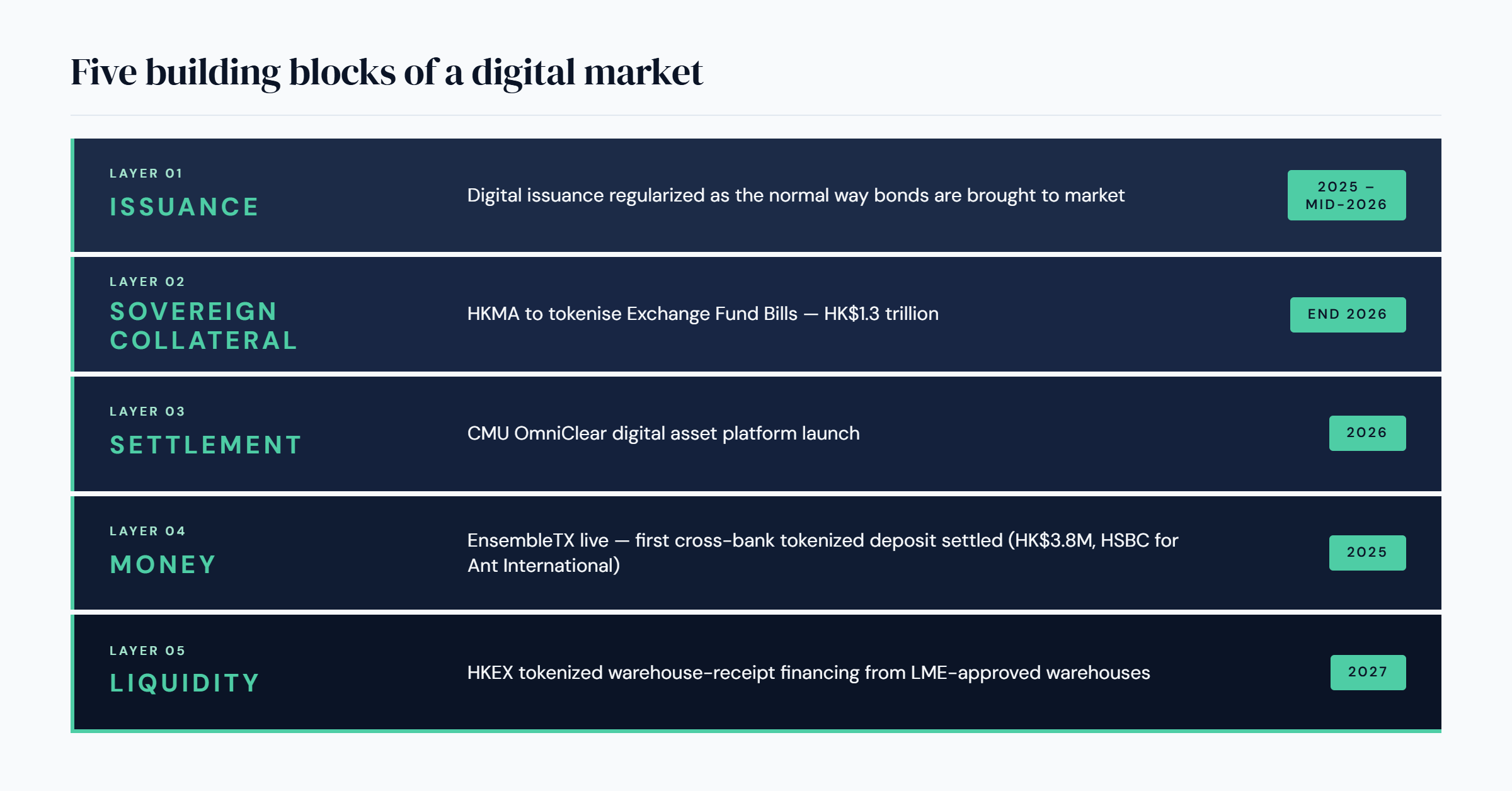
Read the Policy Address closely and the initiatives interlock. Together they cover every step of how a financial market works: how an asset is created, what backs it, how it changes hands, what money pays for it, and how it can be turned into cash when needed. Here is how I read what is being built, layer by layer: what each part means, and what is now planned.
1. Issuance: how new securities are born. Issuance is the front door of a capital market: a borrower creates a bond and delivers it to investors. Done digitally, the bond is born directly on a shared ledger instead of in a stack of paper, and everything that happens across its life happens there too. Hong Kong is already the world leader here, and the Policy Address moves it from showcase to standard practice:
Between 2025 and mid-2026, close to half of all digital bonds issued worldwide were issued in Hong Kong; no other market comes close.
Digital issuance will be "regularized": the government intends it to become the normal way bonds are brought to market here, with repeat programs rather than one-off showcases, so that issuing digitally is a routine choice rather than an experiment.
The full life of a bond moves on-chain, not only the sale: settlement in digital currencies, coupon payments and final redemption all happen on the ledger, removing the chain of manual steps in between.
2. Sovereign collateral: the safest assets, made mobile. Collateral is what institutions pledge when they borrow from each other, and the bedrock collateral of Hong Kong's system is the Exchange Fund Bill: short-term, government-grade paper that banks hold in size. Today those bills move only in banking hours, through settlement systems that close in the evening and on weekends:
The Hong Kong Monetary Authority, the city's de facto central bank, will test the tokenization of Exchange Fund Bills by the end of this year.
More than HK$1.3 trillion of outstanding bills, around US$170 billion, would become usable around the clock: collateral that can be pledged, released and reused at any hour, any day.
The signal matters as much as the mechanics: when a monetary authority puts its own instruments on the rails, the rails have ceased to be an experiment.
3. Settlement: where trades actually complete. After any trade, ownership must change hands against payment, reliably and finally. That happens inside a central securities depository, the clearing hub that investors never see and everything depends on. Hong Kong's is operated by CMU OmniClear; in practical terms, the city's bond market runs through it. It is being rebuilt digitally:
A digital asset platform launches this year, giving issuers one place to both issue and settle digital bonds instead of stitching together separate providers.
Its services extend internationally, connecting investors toward Europe, the Middle East, Central Asia and ASEAN, so that paper issued on Hong Kong's rails can be held and settled from anywhere.
A unified framework across bonds and equities is planned, meaning different asset classes would eventually settle through one digital backbone rather than separate legacy systems.
4. Money: what pays for the trade. Every market needs a cash leg, and this is where most digitization efforts stop halfway. If the asset is delivered on digital rails but the payment still crawls across traditional banking rails, only half the trade has been modernized; the point is delivery versus payment in a single step, asset and money moving together, instantly and finally. That requires digital money in regulated forms: tokenized deposits, which are ordinary commercial bank money recorded on a ledger; central bank digital currency, the same for central bank money; and regulated stablecoins, licensed tokens redeemable one-for-one for currency.
I still remember Eddie Yue, Chief Executive of the Hong Kong Monetary Authority, on stage at the launch of EnsembleTX almost a year ago. His message to the assembled participants: the time of white papers is over. The name carries the point, because the TX stands for transaction; the program exists to produce real activity in real volumes. One year on, that ambition is reflected in concrete waypoints:
Interbank settlement of tokenized deposits is live: the first cross-bank transaction, HK$3.8 million settled by HSBC for Ant International, is done.
Settlement in central bank digital currency, operating 24/7, is planned around the end of this year.
Tokenized deposits extend into trade finance with the Mainland, with pilots completing this year.
The Securities and Futures Commission will promote regulated stablecoins, traded on licensed platforms, for settling tokenized money market funds, and the first tokenized money market funds are now being authorized.
EVIDENT is proud to participate in EnsembleTX alongside institutions such as HSBC, Standard Chartered, Bank of China (Hong Kong), BlackRock and Franklin Templeton, essentially the only young firm in a cohort of global incumbents, and we are preparing to use regulated stablecoins in the settlement of tokenized money market funds. We mention this as evidence for the point that matters most: none of this is theory. These are real transactions, between named institutions, on published dates.
5. Liquidity: turning assets into cash. Liquidity is the ability to convert an asset into money quickly without destroying its value, and it is the quality most of the world's assets lack. The most far-reaching item in the Policy Address concerns exactly this. Warehouse receipts are the title documents to metal sitting in approved warehouses: real and valuable, but traditionally slow and cumbersome to borrow against. HKEX, Hong Kong Exchanges and Clearing, the operator of the city's stock exchange, which raised more money from new listings last year than any exchange in the world, is changing that:
HKEX is building a blockchain-based platform for tokenizing multiple asset classes; carbon credits are already live on it.
Warehouse receipts from LME-approved metal warehouses begin piloting on the platform next year.
By 2027, tokenized warehouse-receipt financing is planned: a company with metal in a warehouse could pledge the tokenized receipt and draw working capital against it in hours rather than weeks.
Hold on to that mechanism, because it is the deepest point in the whole document. A government and its exchange are using tokenization for precisely the purpose we have always argued it exists: manufacturing liquidity from assets that never had it.
Private markets are next
Look at the sequence of what is being put on the rails, because the sequence is the tell. Governments digitize what they control first: their own bills and bonds. Then what is already exchange-traded: funds, gold, commodities, receipts. Each step is larger and less liquid than the one before. Follow the line one step further and it points at the largest and least liquid asset pool in finance: private markets.
Consider what is waiting at that destination, and where it is waiting. Private assets are the asset class where the frictions these rails remove are heaviest: paper subscription chains, weeks-long transfers, ownership registers reconciled by hand, positions locked for a decade. Every building block above maps directly onto a private-markets problem that we and our clients live daily. Digital issuance maps to access: professional investors and private wealth reaching assets that operational cost once reserved for the largest institutions. Instant settlement in tokenized money maps to speed. And tokenized collateral maps to the deepest gap of all, liquidity, above all in this region, where, as we have written before, the inventory of aging private assets towers over the thin base of capital equipped to trade it. All of this in the city that now books more cross-border private wealth than any other place on earth. The assets and the capital are converging on the same postcode, and the rails between them are being laid in public.
Building that connection is what we have spent years on, as a licensed principal investor that commits its own capital alongside its clients. So we read last week's documents less as news than as confirmation, and we will say publicly what we told the government behind closed doors: we welcome the industry this will create. Rails carry more traffic than any single train. Markets are built by many hands, and the tide this city has decided to raise will lift every boat on it, ours and others'. To anyone building toward the same future, from incumbent institutions to founders at the edge: our door is open.
This week, within twenty-four hours, the world was shown two very different ways of approaching the same future. Different systems will take different roads at their own speeds, and global markets will be better for having more than one engine. Our own conclusion is not political at all. It is that there has rarely been a better moment to build digital market infrastructure, and there may be no better place on earth to build it than the city that just published its timetable. Hong Kong has set its direction and asked the industry to build alongside it. We intend to.
This piece is published by EVIDENT for general informational purposes. It reflects the views of the author and draws on public government documents and reporting as cited, including the First Five-Year Plan for Economic and Social Development of the HKSAR (2026–2030), the 2026 Policy Address, and Hong Kong Monetary Authority announcements. It is not investment advice, a recommendation, or an offer to subscribe for any product. EVIDENT Platform Services Limited (CE No. BTR490) is licensed by the Securities and Futures Commission of Hong Kong for Type 1 regulated activities.