From Tasks to Workflows: Agentic AI in Capital Markets
Private capital continues to flow into long-life infrastructure, from energy networks to ships on long-term charters, and the way these investments are managed is changing as well. Drawing on 2026 research from BCG, McKinsey, Deloitte, The Private Markets Forum, the HKMA and the FTAHK, this piece looks at how AI in capital markets is moving from individual tasks to agentic workflows, and how Hong Kong is shaping that shift.
Devanshee Kothari
Growth and Research Manager
Published
October 28, 2026
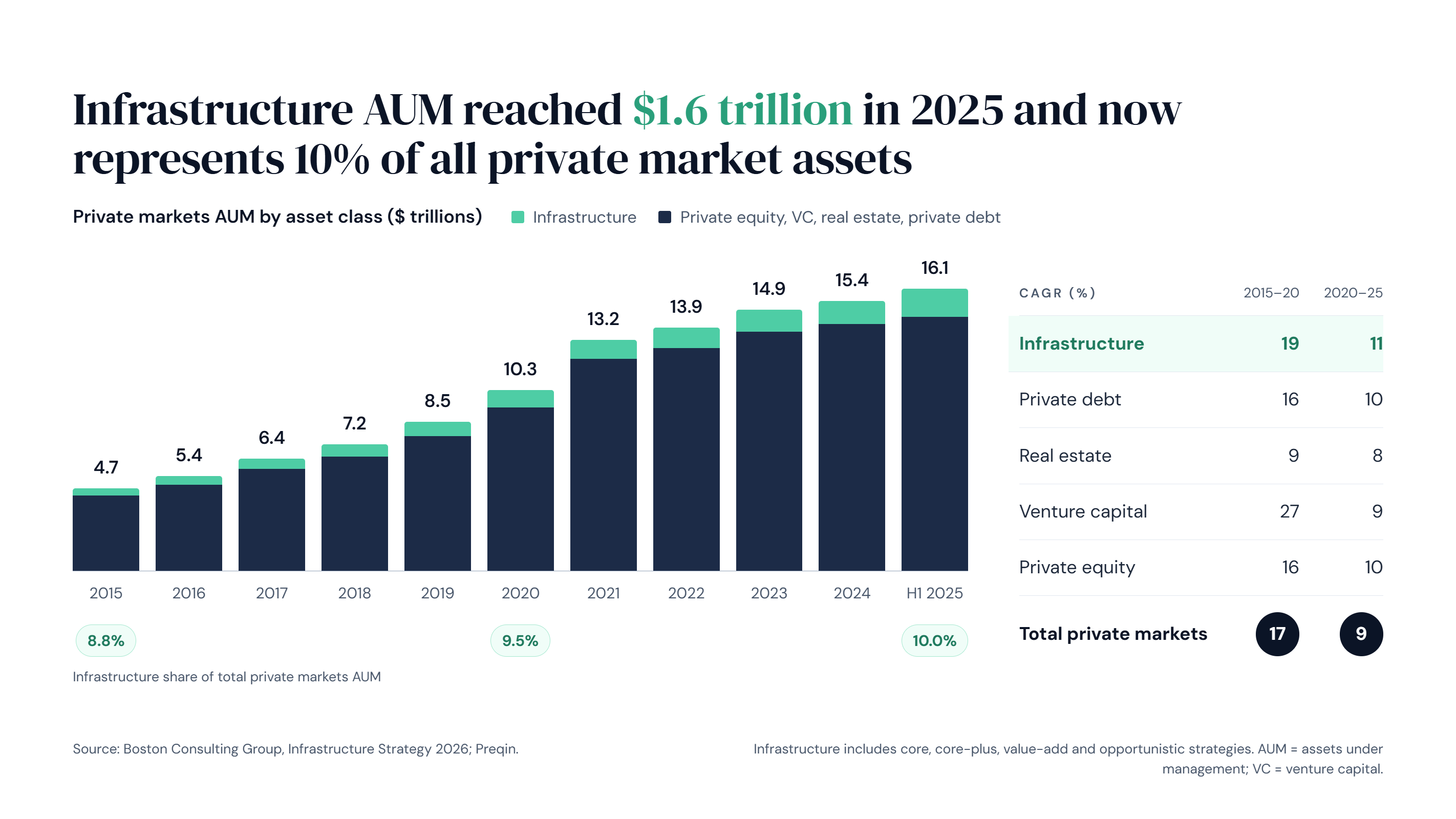
Infrastructure has become a substantial part of private markets. BCG's Infrastructure Strategy 2026 puts infrastructure assets under management at USD 1.6 trillion in the first half of 2025, or 10% of all private-market assets. The asset class now reaches well beyond roads and power grids. BCG includes maritime segments such as LNG carriers and specialized offshore vessels, which, when chartered long-term or bareboat, generate stable, contract-driven revenue.
These assets are diverse and long-lived, and the information behind them is often complex and unstructured. McKinsey's Global Private Markets Report 2026 notes that this reliance on complex, unstructured data positions infrastructure to benefit disproportionately from AI, while BCG's Infrastructure Strategy 2026 identifies the adoption of AI among the most important levers for improving margins at private equity-owned infrastructure companies.
The same pattern runs through the funds that invest in these assets. Deloitte observes that in infrastructure, significant asset diversity makes standardization difficult, one of several reasons private-market operations remain complex. This is where the next phase of AI in capital markets is taking shape: a move from tools that help with individual tasks to agents that coordinate workflows across systems, with people setting the boundaries and remaining accountable for the outcomes.
Broad adoption, early agentic deployment
Deloitte's March 2026 analysis, Rethinking alternative investment operations: Agentic AI and the path to smart, autonomous workflows, notes that 95% of fund managers already use generative AI, citing research by the Alternative Investment Management Association. Most, however, use it to automate isolated tasks rather than to rethink how their operations run. Deloitte sees the potential for agentic AI across functions as much higher, with deployment still low, and attributes the gap to operating model readiness and risk management discipline rather than the maturity of the technology.
BCG's Global Asset Management Report 2026 reaches a similar conclusion for the wider industry. It finds that asset managers trail banks and fintech firms in scaling AI across core processes, with most still focused on pilots and incremental productivity gains.
Private markets are moving into production
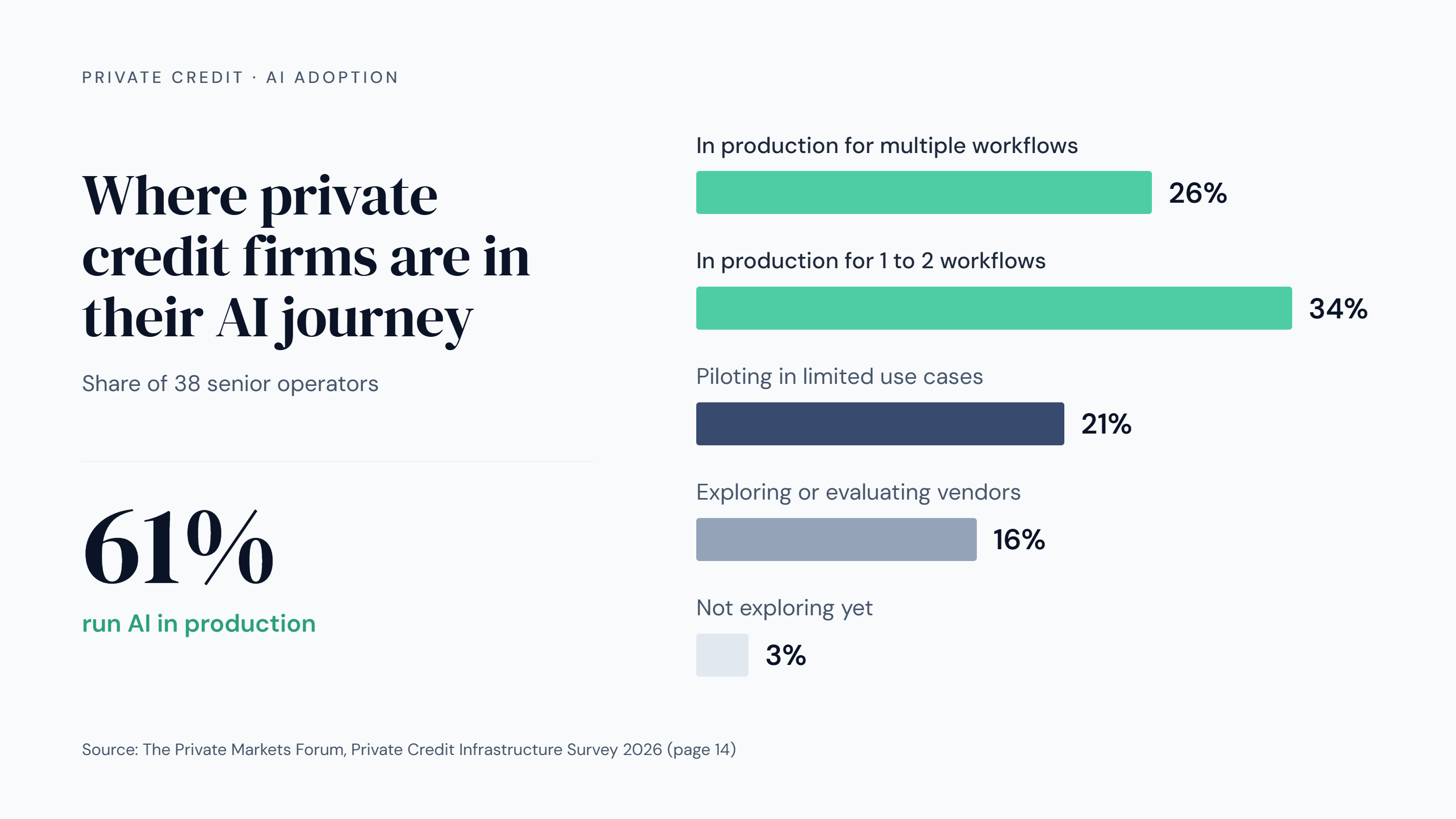
Private markets offer a clear view of where this is heading. In The Private Markets Forum's Private Credit Infrastructure Survey 2026, Infrastructure at the Edge of Scale, 61% of the 38 senior operators surveyed said their firms run AI in production for at least one workflow, and 26% across multiple workflows. Document extraction is the most common starting point.
Deloitte explains why alternatives are a natural setting for agentic workflows. Longer holding periods extend oversight, complex fund structures resist standardization, jurisdiction-specific rules add to compliance work, and investors expect more transparency. Data is spread across portfolio companies, administrators and internal systems. Deloitte also notes that, unlike banking and insurance, alternatives are not bound by decades of legacy systems, which allows operating models to be designed around agentic AI from the start.
What an agentic workflow looks like
Deloitte uses investor reporting as an example. Today, a fund accountant gathers data, a compliance officer reviews regulatory requirements, an operations manager coordinates with administrators and investor relations finalizes the materials, through a chain of handoffs and emails. In an agentic model, an agent orchestrates the data gathering, applies jurisdiction-specific rules and assembles draft reports in each investor's format, while people retain ownership of the outcome and focus on judgment.
BCG describes the same shift across investment operations, with agentic systems coordinating fund accounting, reconciliations, portfolio analytics, corporate actions and reporting. In private markets, it points to agents that can process capital calls, interpret unstructured documents, and calculate and validate waterfall distributions. BCG estimates that agentic workflows can increase operational capacity by 55% to 65% and reduce operational costs by around 40%.
Foundations come first
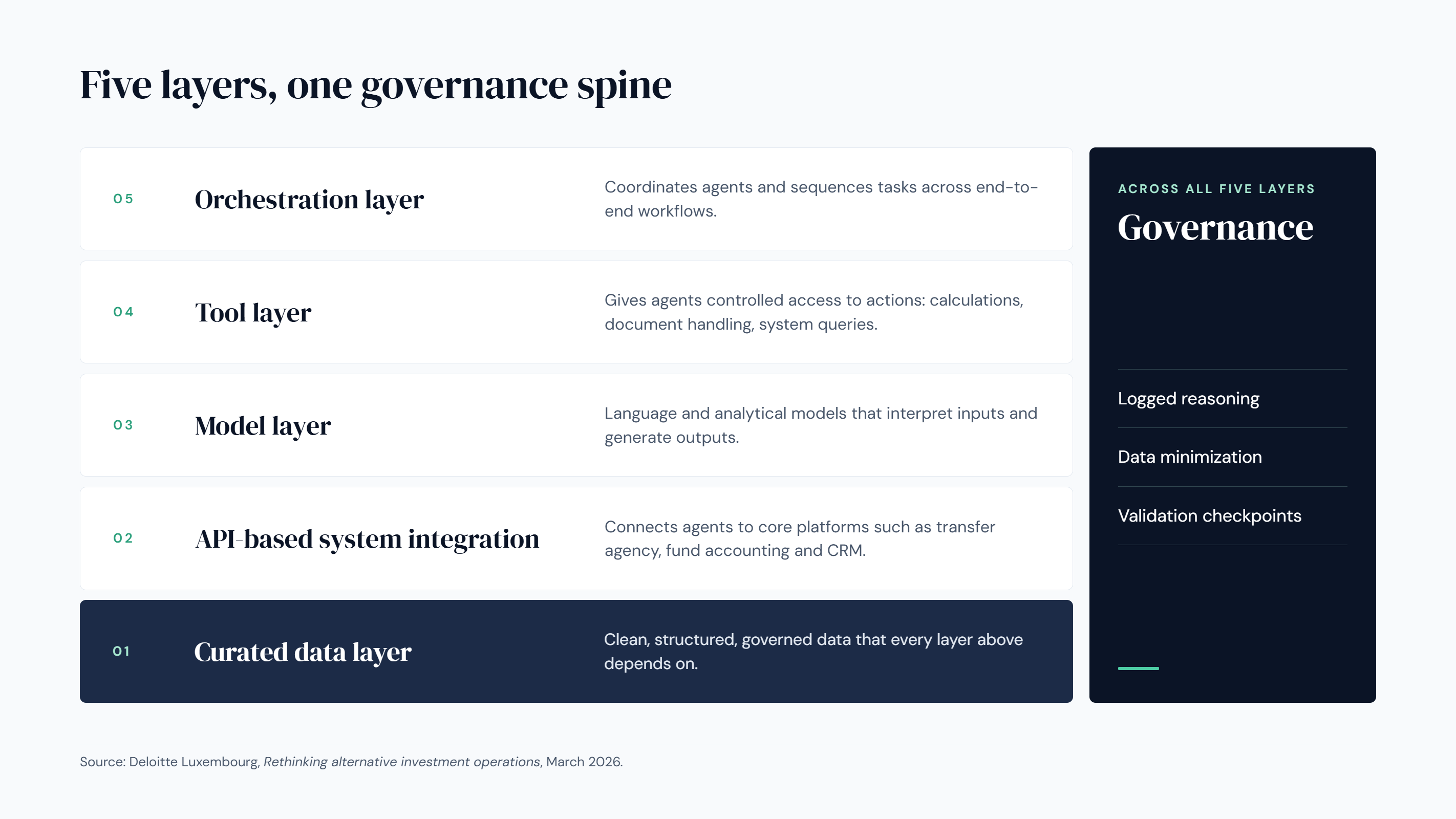
Both firms are clear that agents depend on what sits beneath them. Deloitte sets out the layers required: a curated data layer that exposes enterprise data and documents securely, API-based integration between systems, a model layer with versioning and monitoring, a tool layer that makes core applications available to agents, and an orchestration layer that manages coordination, escalation and exceptions.
Governance is designed in rather than added later. Deloitte points to logged reasoning paths, data minimization by default and validation checkpoints before actions take effect, and recommends building trust incrementally, starting with contained deployments and expanding autonomy as reliability is demonstrated.
Hong Kong is working through this in practice
Hong Kong offers one of the clearest views of how agentic AI is being adopted under supervision. In opening remarks at the Finance + A.I. Forum on October 16, 2026, Carmen Chu, Executive Director (Banking Supervision) at the Hong Kong Monetary Authority, said more than 60% of use cases in the second cohort of the GenA.I. Sandbox involved AI agents, half of them multi-agent applications. Results shared from the cohort included a 40% reduction in customer-onboarding time and a 95% shorter cycle for case-specific risk analysis. The HKMA's latest supervisory guidance is built around its ART framework of Accountability, Resilience and Trust.
Industry is moving in parallel. In the survey of 103 financial institutions behind the Fintech Association of Hong Kong's position paper, Artificial Intelligence in Financial Services: The Way Forward for Hong Kong (April 2026), customer service automation, risk assessment and management, and regulatory compliance monitoring were the areas most often cited for AI applications, by 84, 67 and 50 respondents respectively. The paper sets out a roadmap that begins with common governance templates and AI-ready data foundations.
The direction of travel
Taken together, the research describes an industry moving from AI that assists with tasks to agents that carry workflows, across private markets from infrastructure to private credit, with data foundations, system integration and governance setting the pace. Hong Kong, with an active supervisory sandbox and an industry roadmap, is one of the markets where that shift is being worked through in practice.
These are among the questions we will explore at Agentic Workflows for Capital Markets in Hong Kong on Wednesday, November 4.