From Exit Route to Liquidity Channel: What the 2026 Secondaries Data Shows
Distributions in private equity remain well below their long-term average, and investors are turning to the secondary market for liquidity. Drawing on 2026 research from McKinsey, Jefferies, Evercore, Lazard and Ropes & Gray, this piece looks at how LP-led and GP-led secondaries have become a structural source of liquidity in private markets, and who that liquidity now reaches.
Devanshee Kothari
Growth and Research Manager
Published
November 26, 2026
The liquidity gap
LP liquidity needs remain a central source of secondary market activity, according to Ropes & Gray's H1 2026 Secondaries Update, with annual distribution yields holding near 10% in the first half of 2026, well below the long-term historical average of approximately 25%. McKinsey's Global Private Markets Report 2026 describes liquidity for investors as more a trickle than a flood, and puts the typical holding period for a private equity portfolio company at more than six and a half years.
McKinsey's report also explains what that means for investors: LPs demand more than paper returns. That imperative is causing LPs and GPs alike to turn to a full suite of liquidity solutions, including partial realizations and a larger secondary market.
A record first half for secondaries
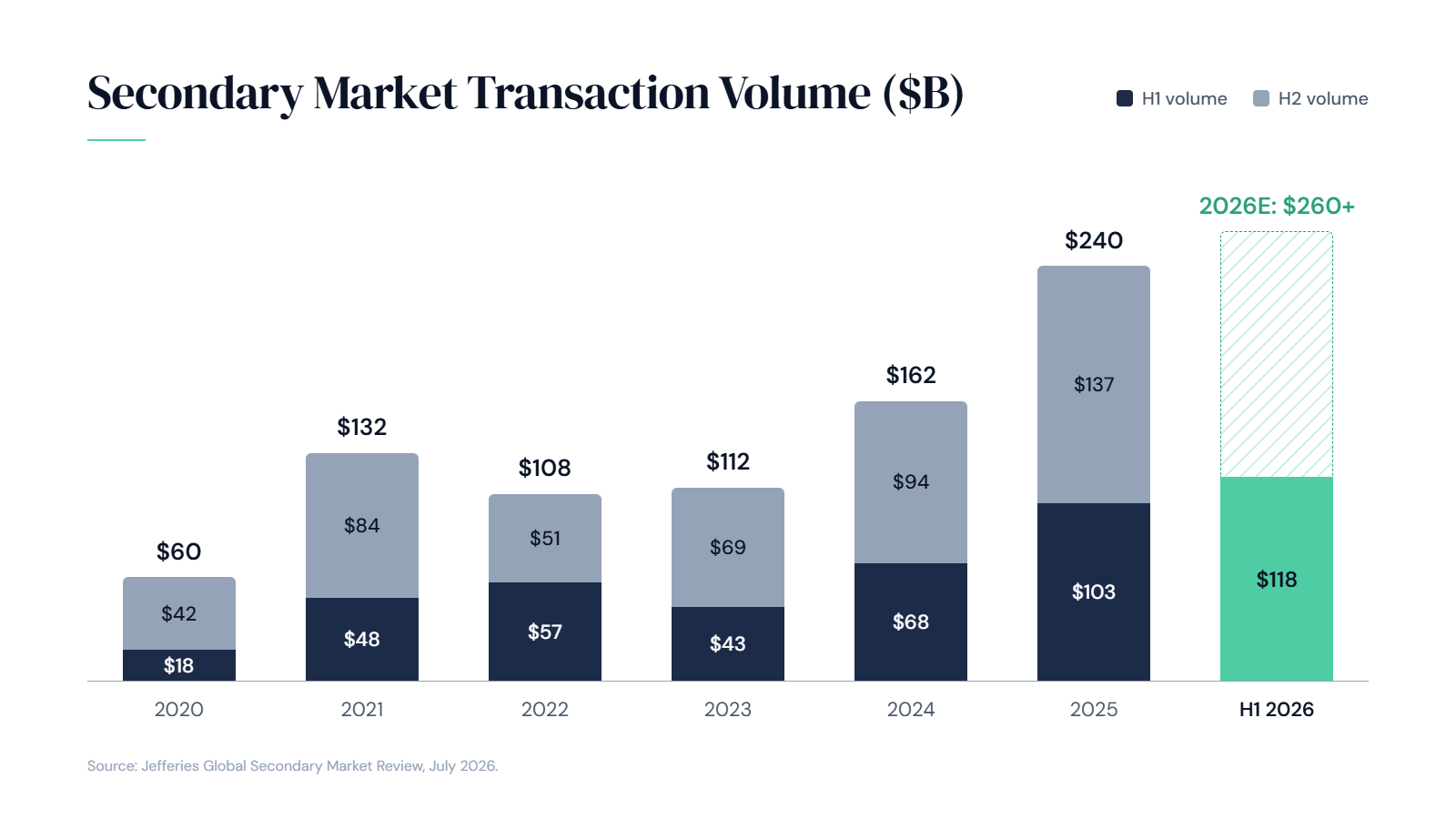
McKinsey reports that secondaries volume grew 48% to a record $240 billion in 2025.
The first half of 2026 set a new first-half record in each of the three leading market reviews. Each firm uses its own data and methodology, so their totals differ:
Jefferies' Global Secondary Market Review counts $118 billion, 15% above the $103 billion recorded in the first half of 2025.
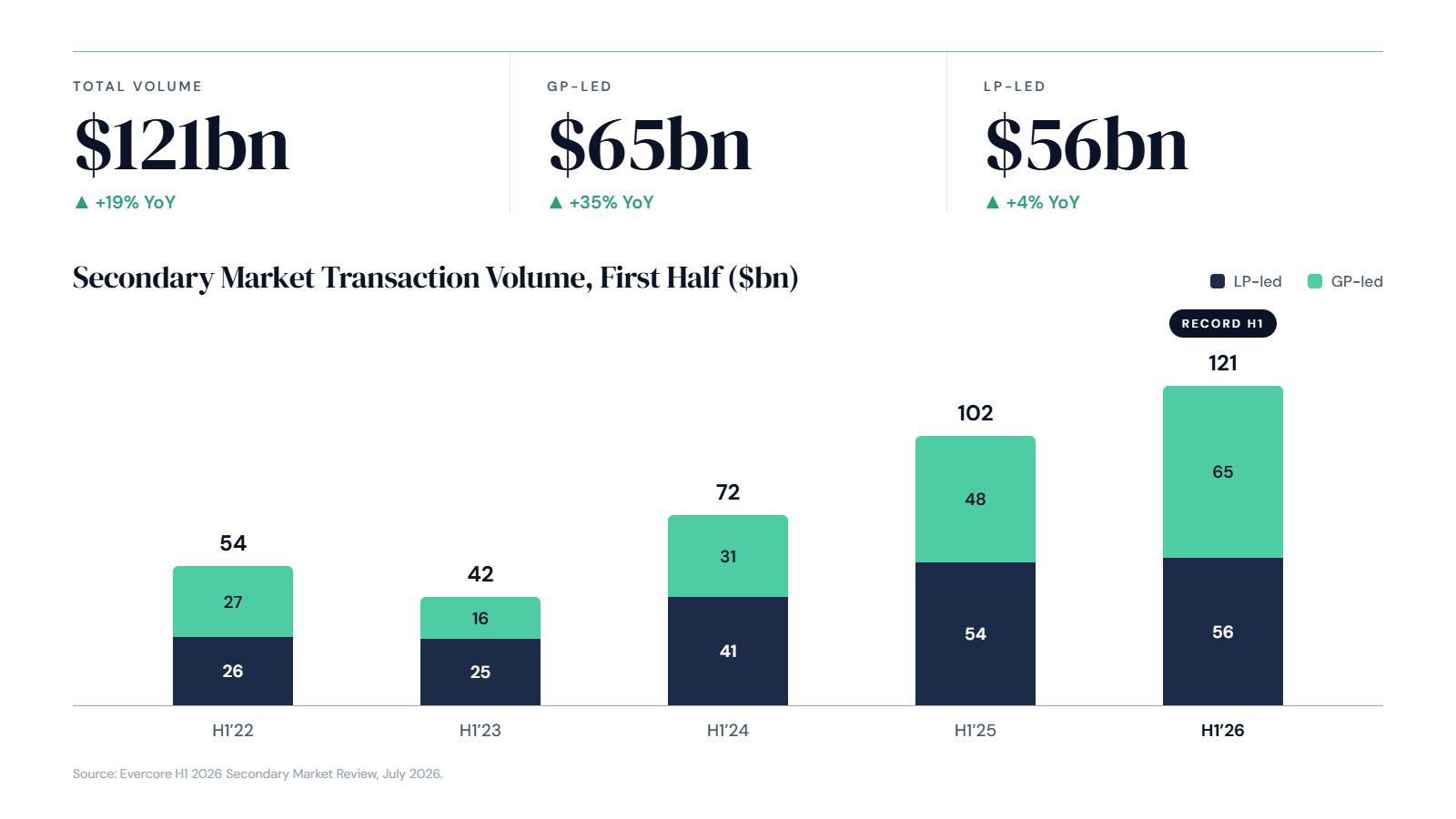
Evercore's H1 2026 Secondary Market Review counts approximately $121 billion, up about 19% year over year.
Lazard's Interim 2026 Secondary Market Report estimates $124 billion, up approximately 28%, and approximately $260 billion over the trailing twelve months.
Evercore describes this as secondaries' evolution from an episodic liquidity solution into a structural portfolio management channel. Lazard similarly calls the secondary market a structurally growing source of liquidity and portfolio management.
Two routes to liquidity
Secondary liquidity comes through two routes, and both grew in the first half of 2026.
In LP-led transactions, investors sell their fund interests to secondary buyers. Jefferies puts LP volume at $56 billion, or 47% of total activity, and says LP supply was primarily driven by LPs' need to generate or accelerate liquidity, as regular-way private equity distributions remain low. Average pricing for LP portfolios remained stable at 87% of net asset value.
In GP-led transactions, fund managers create liquidity themselves, most often through continuation vehicles. Evercore counts approximately $65 billion of GP-led volume in the first half of 2026, up 35% year over year, compared with approximately $56 billion of LP-led activity. Jefferies puts GP-led volume at $62 billion, with continuation vehicles accounting for 89% of it. McKinsey estimates that 14% of all sponsor-backed exits now go through continuation vehicles.
Who the liquidity reaches
The buyer side of the market is changing too. In Lazard's survey of secondary investors, 40% manage evergreen or '40 Act vehicles. Ropes & Gray's August 2026 Principal View notes that private allocations in wealth are growing three times faster than institutional allocations, and that many traditional managers lack the distribution to serve them.
The direction of travel
Lazard notes that sponsors and limited partners remained motivated to create incremental liquidity through the first half of 2026. Jefferies expects full-year 2026 volume to exceed approximately $260 billion, above the 2025 record of $240 billion.